Most Side Hustle Advice Is Trash. Here Is What Actually Works.
Type "side hustle ideas" into Google. You will get the same five recycled suggestions on every single page. Drop shipping. Print on demand. Take online surveys. Become a virtual assistant. Start a blog about side hustles.
Most of this advice was written by content marketers who have never done a side hustle in their lives. They read each other's articles, rewrite them slightly, and publish. The blind leading the blind.
Here is the advice worth listening to.
💡 The first rule of side hustles: if someone is selling a course about it, the real money is in the course, not the side hustle.
"Take Online Surveys" Is Not a Side Hustle
This is the most common suggestion and also the worst. Spending 25 minutes answering questions about your laundry detergent preferences for $0.40 is not a side hustle. It is trading your time for pocket change.
The people recommending surveys have either never done one, or they did exactly one and extrapolated wildly. "I made $2 in an hour, so if you do this 40 hours a week, that's $80!" This math is technically correct and completely useless. You cannot scale survey taking. The pay does not improve with experience. There is no career path.
If you genuinely want to earn money online through tasks, skip the consumer survey sites entirely. Go straight to platforms where the pay is tied to actual value.
Prolific pays $9 to $15 per hour for academic research studies. The work is more interesting, the pay is higher, and you are contributing to actual research instead of helping a corporation optimize their ad spend.
UserTesting pays $10 for a 20 minute test. You browse a website, speak your thoughts out loud, and get paid exactly one week later. No screener hell like the survey sites. No getting disqualified after 15 minutes of questions.
These are still not going to replace a full time job. But they pay 5 to 10 times what survey sites pay for the same time investment. That is the difference between a scam and a legitimate micro task.
Actual micro-task platforms that pay →
Drop Shipping Is Not Passive Income
Drop shipping is sold as the ultimate passive income dream. Find a product on AliExpress, mark it up, run some Facebook ads, and wake up rich. The reality is that you are running a real ecommerce business with razor thin margins and customer service headaches.
For every success story you see, there are hundreds of people who lost money on ads, got chargebacks from angry customers waiting three weeks for shipping, or had their ad account banned by Facebook for no clear reason. The survivors are the ones you hear about. The failures are invisible.
The people who actually make money from drop shipping are the ones selling courses about drop shipping. Think about that for a second. If the business model was truly profitable at scale, why would they need to sell courses?
This does not mean ecommerce is dead. It means the specific model of slapping your logo on a generic product and hoping for the best is dead. The people winning at ecommerce now build actual brands, create unique products, or sell digital goods with zero fulfillment costs.
Digital products that actually sell →
"Just Start a Blog" Is Incomplete Advice
Starting a blog is good advice. It is also incomplete to the point of being useless. A blog without a monetization strategy is a diary. A diary does not pay rent.
The people telling you to start a blog conveniently leave out the part where most blogs never make a single dollar. The content mills have chewed up and spit out millions of abandoned blogs. Two posts in January, one in March, nothing since. The internet is a graveyard of good intentions.
A blog works when it is the top of a funnel, not the entire business. You need something to sell. A digital product, a freelance service, an affiliate offer you genuinely believe in, or a newsletter people pay for. The blog is how people find you. The product is how you get paid.
Without the product, you are just writing for free and hoping Google sends traffic. Google is not sending traffic to your three month old blog with 12 posts. That is not how SEO works in 2026.
How people actually turn side hustles into income →
What Actually Works: The Boring Stuff Nobody Talks About
The side hustles that work are not glamorous. They do not make good TikTok content. They are repetitive, small scale, and deeply unsexy. That is exactly why they work. The hype seekers ignore them, so there is less competition.
Micro tasks on Prolific and MTurk will never make you rich. They will make you $50 to $200 a month for a few hours of evening work. That covers a utility bill. That is not nothing.
Selling digital products on Etsy sounds boring until you realize a single spreadsheet template created in an afternoon can earn $50 a month for years with zero additional effort. Make five of those. Now you have $250 a month in mostly passive income. Still not quitting your job, but your car payment just got a lot less stressful.
Freelancing on Fiverr or Upwork is a grind at first. $15 gigs. Demanding clients. Five star ratings that feel like life or death. But after 20 or 30 gigs, something shifts. Your ratings are solid. Your process is smooth. You raise your prices. $15 becomes $50 becomes $100. A year in, you are making more per hour than your day job.
This is not exciting. It is reliable. And reliability compounds in ways that excitement never does.
The side hustles that work are boring. They require consistency, not brilliance. They take months to build, not days. But once built, they pay reliably. That beats the alternative of chasing shiny objects forever.
How to Spot Trash Advice Instantly
There are four red flags that tell you a side hustle recommendation is worthless before you even finish reading.
Red flag one: The article mentions "unlimited earning potential." Real side hustles have real limits. Platforms have daily caps. Time has limits. Anyone promising unlimited anything is lying.
Red flag two: There is a course for sale. If the real money was in the side hustle, they would not need to sell you a course about how to do it. They would just do the side hustle.
Red flag three: The numbers do not add up when you think about them for five seconds. "I make $10,000 a month taking surveys!" There are not enough surveys in the world to make $10,000 a month taking them.
Red flag four: The advice is exactly what you have read on ten other sites. Same suggestions. Same platforms. Same vague promises. These articles were written by AI or by content marketers who have no firsthand experience.
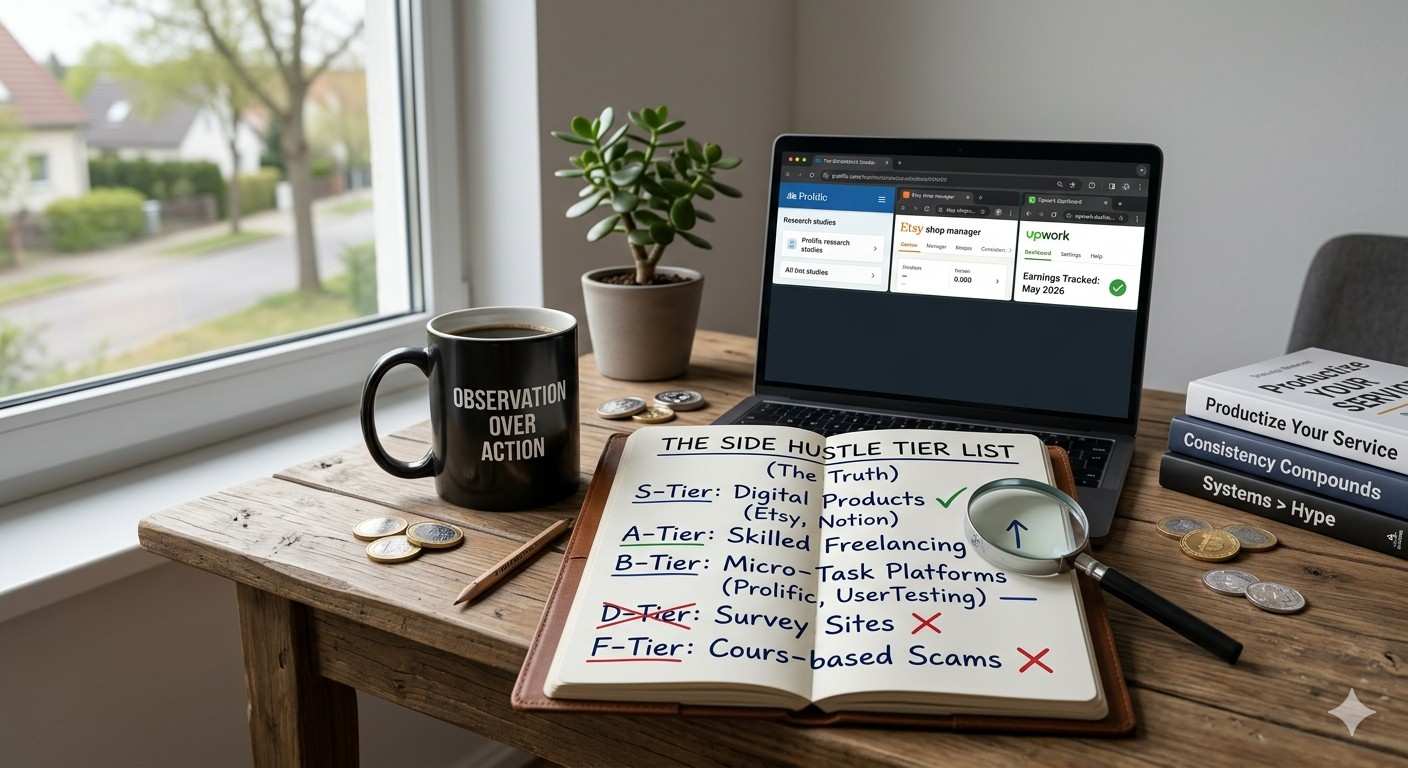
The Side Hustle Tier List
Not all side hustles are created equal. Here is how they actually stack up.
| Tier | Type | Examples | Monthly Potential | Sustainability |
|---|---|---|---|---|
| S Tier | Digital products | Etsy templates, Notion dashboards | $100 to $2,000+ | Years, mostly passive |
| A Tier | Skilled freelancing | Copywriting, design, coding | $500 to $5,000+ | Years, active but flexible |
| B Tier | Micro-task platforms | Prolific, MTurk, UserTesting | $50 to $300 | Ongoing, active |
| C Tier | Entry freelancing | Fiverr, Upwork beginners | $100 to $500 | Months, active |
| D Tier | Survey sites | Swagbucks, Survey Junkie | $10 to $50 | Dead end |
| F Tier | Anything with a course | Dropshipping courses, crypto courses | -$500 | Scam |
S Tier is where you want to be. Create once, sell forever. A Tier is where most successful freelancers land. B Tier is a solid starting point while you build toward something better. Everything below that is a distraction.
How to stack multiple income streams →
💡 If you take one thing from this article, let it be this: ignore any side hustle advice that sounds exciting. Excitement is a signal that someone is selling you a dream. The real money is in the boring, consistent, unglamorous work that nobody makes TikToks about.