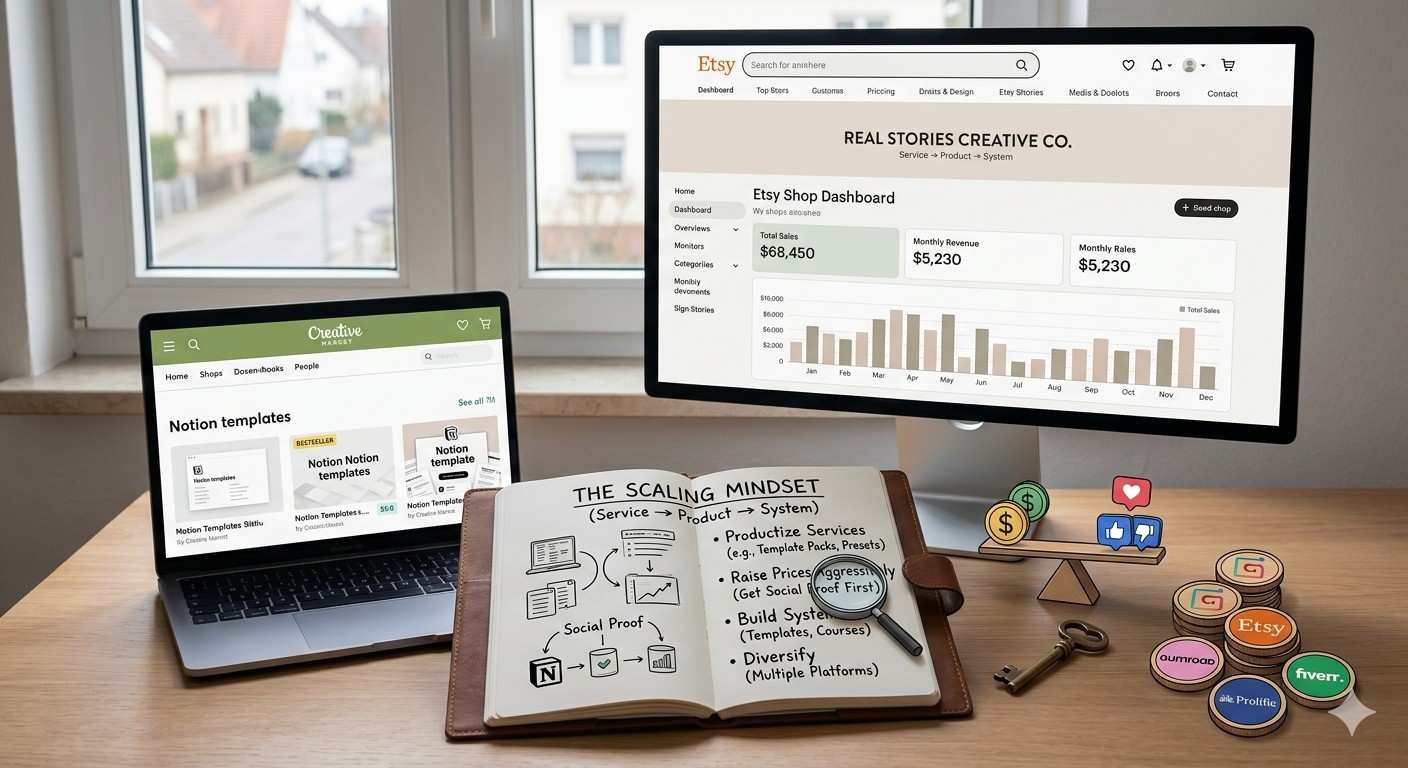
Side Hustles That Actually Became Full-Time Jobs for Real People
Most side hustles stay side hustles. A few hundred dollars per month. Extra cash for groceries or a weekend trip. That is the realistic outcome for most people, and it is a perfectly good one.
But some side hustles grow into something bigger. Not because the people were luckier or smarter. Because they did a few specific things differently from the start.
Here is what those people did, and how you can apply the same approach to your own side hustle.
💡 The difference between a side hustle that stays small and one that replaces a full-time job is not the type of work. It is the approach to growth.
They Treated a Service Like a Product
Most freelancers trade time for money. Design a logo, get paid. Write a blog post, get paid. Edit a photo, get paid. The income stops when the work stops.
The people who scaled their side hustles turned services into products. Instead of designing custom logos for $100 each, they created logo templates and sold them for $25 each on Creative Market. One template sold 50 times earns more than five custom logos and requires zero additional work after creation.
Instead of writing custom blog posts for clients, they wrote template packs for specific industries. A pack of 10 real estate blog post templates priced at $39. Real estate agents buy them, customize them, and publish. The writer does the work once and sells it repeatedly.
Instead of editing photos one at a time for clients, they created Lightroom preset packs. One preset pack priced at $19 can sell hundreds of times on Etsy or Gumroad. Zero ongoing work after the initial creation.
The shift from service to product requires upfront effort but creates leverage. You work once and get paid many times. That is the foundation of scaling any side hustle.
More passive income ideas most people ignore →
💡 Ask yourself: what do my clients all have in common? What problem do they all share? Build a product that solves that problem once, instead of solving it individually for every client.
They Raised Prices Aggressively After Getting Proof
Most side hustlers undercharge for years. They start at $15 per gig and stay there because they are afraid of losing clients if they raise prices.
The people who scaled did the opposite. They started low to get their first few clients and collect reviews. Then they raised prices aggressively.
A freelance writer starts at $25 per blog post. After five posts and five positive reviews, the price goes to $50. After ten more posts, it goes to $100. Within six months, the same writer charges $200 per post and works with better clients who value quality over price.
A Notion template seller starts at $12 per template. After ten sales and a few reviews, the price goes to $25. After fifty sales, the price goes to $45. The template did not change. The perceived value changed because of social proof.
The fear of losing clients by raising prices is mostly unfounded. Yes, some price sensitive clients will leave. But they are replaced by clients who pay more, expect less hand holding, and respect your time. The total revenue goes up even if the total number of clients goes down slightly.
5 side hustle mistakes costing you money →
They Built Systems Instead of Just Working Harder
Working more hours is not a growth strategy. There are only so many hours in a day. The people who scaled built systems that did the work for them.
A virtual assistant who manages inboxes for five clients might earn $2,500 per month. A virtual assistant who creates email management templates and sells them on Gumroad for $29 might earn $3,000 per month with zero ongoing client work. The difference is not talent. It is building a system once instead of working every day.
A user tester who completes 20 tests per week might earn $200. A user tester who creates a course teaching others how to pass the sample test and get accepted might sell that course for $49 to hundreds of people. The testing work provides income. The course builds a system that earns while they sleep.
Systems take time to build. A template might take 10 hours to create. A course might take 40 hours. But once built, they earn indefinitely. The time investment pays off permanently.
Free tools to create digital products in under an hour →
They Ignored the Wrong Metrics
Most side hustlers obsess over follower counts, likes, and platform ratings. The people who scaled obsessed over revenue per hour and customer lifetime value.
A 4.9 star rating on UserTesting feels good but does not pay the rent. A Fiverr profile with 500 reviews is impressive but might represent hundreds of hours of underpaid work. The metrics that matter are how much you earn per hour of effort and how long a customer continues to buy from you.
Someone earning $15 per hour on UserTesting might feel productive. Someone earning $50 per hour from selling digital products on Etsy might feel like they are barely working. Both might earn $500 per month. The difference is that one person worked 33 hours and the other worked 10 hours.
Shift your focus from vanity metrics to revenue metrics. How much did I earn per hour this month? How many customers came back? How many products sold while I was sleeping? These questions lead to better decisions than checking profile ratings.
How to manage side hustle income without losing track →
They Diversified Before They Needed To
Most side hustlers rely on a single platform for all their income. When that platform changes its algorithm, bans their account, or reduces pay rates, their income disappears.
The people who scaled built multiple income streams before the first one stopped working. A freelance writer on Fiverr also sells templates on Etsy and earns affiliate commissions from a small blog. If Fiverr changes its fee structure, two other income streams are unaffected.
A user tester on UserTesting also does studies on Prolific and sells digital products on Gumroad. If UserTesting has a slow week, the other platforms fill the gap.
Diversification feels unnecessary when one platform is working well. It feels essential when that platform stops working. The people who scaled diversified before the crisis, not during it.
The $500 side hustle stack →
What Separates the People Who Scaled
They did not have special skills or secret knowledge. They did not work 80 hour weeks. They made four specific decisions that compound over time.
They turned their service into a product they could sell repeatedly. They raised their prices after getting proof that people would pay. They built systems that earned money without their direct time. They diversified their income across multiple platforms so no single change could destroy their business.
None of these decisions require talent or luck. They require a shift in thinking from trading time for money to building assets that pay repeatedly.
A side hustle that replaces a full time job is not a different type of side hustle. It is the same side hustle, approached with a different mindset. Productize. Raise prices. Build systems. Diversify.
💡 Your side hustle today does not have to be your side hustle forever. The same work you are already doing can become a product, a system, or a diversified income stream. It just takes one change at a time.
Pick one of these four strategies. Apply it to your current side hustle this week. See what happens. Then apply another one next month.