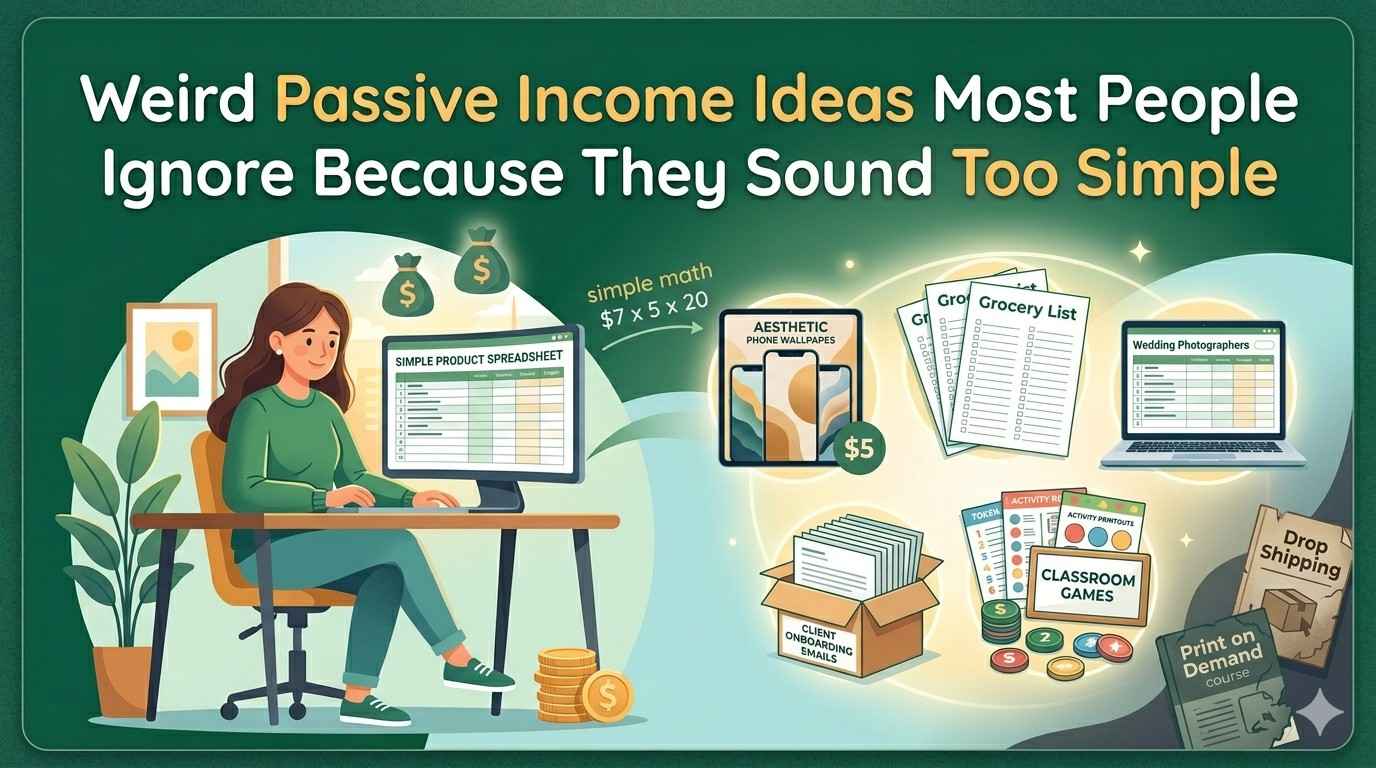
Weird Passive Income Ideas Most People Ignore Because They Sound Too Simple
Everyone chases the same passive income ideas. Drop shipping. Print on demand. Affiliate blogs about making money online. The competition is brutal and the winners are usually the ones who started five years ago.
Meanwhile, a woman in Ohio sells a single page grocery list template on Etsy. She made it in 20 minutes using Canva. It sells 15 copies per month at $3.99 each. She has not touched the listing in over a year.
The most profitable passive income ideas are not glamorous. They are small, specific, and deeply unsexy. But they work.
💡 The pattern: Find something people need repeatedly. Make it once. Sell it forever. The simpler the product, the less customer support it requires.
Why Tiny Products Beat Big Ones
A $200 online course requires video production, curriculum design, and constant updates. It also attracts customers who expect support, refunds, and hand holding.
A $4 printable grocery list requires a single Canva session. Customers download it, print it, and never contact you. If they do contact you, it is usually to say thanks.
The math is counterintuitive. Ten sales of a $200 course is $2,000. But most course creators never reach ten sales because the market is saturated and the trust barrier is high. Five hundred sales of a $4 template is also $2,000. And reaching five hundred sales of something that costs less than a coffee is significantly easier than convincing someone to spend $200 on your expertise.
The sweet spot for passive income is products priced between $3 and $15. Low enough for impulse purchases. High enough that selling a few hundred per month adds up to real money.
Idea 1: Phone Wallpaper Packs
This sounds ridiculous. Selling phone wallpapers? Who pays for phone wallpapers?
A surprising number of people. Etsy has entire shops dedicated to phone wallpaper packs with thousands of sales. The aesthetic wallpaper category alone generates millions in revenue annually.
Why This Works
People change their phone wallpaper every few weeks. They want something that looks good, matches their style, and does not look like it came from Google Images. A pack of 10 coordinating wallpapers for $5.99 solves this for months.
How to Make It
Open Canva. Set the canvas size to phone screen dimensions. Create a simple design. A solid background color with a subtle pattern. An inspirational quote in nice typography. An abstract gradient with a minimalist shape.
Make 10 variations. Keep the style consistent so they work as a set. Export as high resolution PNG files. Upload to Etsy as an instant download.
Total creation time is about 90 minutes for your first pack. Less once you develop a style.
What Sells
Aesthetic color palettes do well. Think beige and cream tones, dark moody colors, or soft pastels. Motivational quotes in clean typography are consistently popular. Minimalist patterns like simple shapes and thin lines appeal to people who want something clean. Seasonal packs for holidays, summer vibes, or back to school themes sell in predictable cycles.
💡 Phone wallpaper buyers often purchase multiple packs. List three coordinating packs and mention in each description that matching packs are available in your shop. The cross sell happens automatically.
Idea 2: Printable Grocery and Meal Planning Lists
Nobody wakes up excited to design a grocery list. That is exactly why this market has low competition and consistent demand.
Why This Works
Meal planning is a chore. People search for tools that make it easier. A well designed printable that organizes meals for the week and generates a matching grocery list solves a real, recurring problem.
The product is also naturally viral. Someone uses your meal planner, their friend sees it on the fridge, and asks where they got it. Word of mouth for a printable grocery list sounds absurd, but it happens regularly.
How to Make It
Create a two page PDF. Page one has spaces for Monday through Sunday meals. Breakfast, lunch, dinner, and snacks. Page two is a grocery list organized by store section. Produce, dairy, meat, pantry, frozen.
Add checkboxes next to each item. People love checking boxes. Include a few blank lines for custom items. Add a notes section at the bottom for special instructions or recipe references.
Keep the design clean. One or two colors. Readable fonts. Nothing that uses excessive printer ink because that is a surprisingly common complaint in product reviews.
What Sells
Meal planners with grocery lists built in outsell standalone meal planners because they solve two problems at once. Specialized versions for specific diets like keto, vegetarian, or family meal prep attract dedicated buyers. Vertical layouts that work in a binder or on a clipboard appeal to the home organization crowd.
Idea 3: Spreadsheet Templates for Very Specific People
"The Budget Spreadsheet" is too broad. Thousands of those exist. "The Budget Spreadsheet for Freelance Photographers Who Get Paid Seasonally" is specific enough to own.
Why This Works
Specificity reduces competition to nearly zero. Someone searching for a budget template for freelance photographers will find maybe three results. If your product is one of them and looks professional, you get the sale.
Specific products also command higher prices. A generic budget template sells for $4.99. A specialized budget template for a niche profession sells for $12.99 because the buyer perceives it as custom made for their situation.
Niche Ideas That Are Underserved
Freelancers with irregular income need a spreadsheet that accounts for feast and famine months. Wedding photographers who get paid in seasonal lumps are an example.
People paying off specific types of debt want a debt snowball calculator tailored to student loans rather than general debt.
Small service businesses like house cleaners, pet sitters, or personal trainers need a client booking and income tracker that understands their workflow.
Landlords managing a few properties want a rental income and expense tracker that handles maintenance costs and tenant details.
How to Make It
Start with a generic template for the category. Then customize it. Change the labels to match the niche language. Add or remove columns that make sense for that specific person. Write a description that speaks directly to their situation.
"What if you knew exactly how much to set aside during wedding season to cover your bills during the slow winter months? This spreadsheet was built specifically for freelance photographers who deal with seasonal income swings."
Idea 4: Email Templates for Specific Situations
Writing emails is annoying. Most people recycle the same templates over and over. Selling a pre written pack of templates for a specific situation saves people hours of staring at a blank screen.
Why This Works
Email templates have zero delivery cost. No PDF to format. No design work. Just a Google Doc with copy pastable text. The perceived value is high because the time savings is obvious. Reading this sentence takes 3 seconds. Writing an effective customer service email from scratch takes 15 minutes.
Template Packs That Actually Sell
Customer service responses for small businesses that cover the 10 most common situations like shipping delays, refund requests, and out of stock notifications.
Client onboarding sequences for freelancers that include welcome emails, project timelines, payment reminders, and follow up templates after project completion.
Difficult conversation scripts for managers that cover things like denying a raise request, addressing poor performance, or explaining why a project deadline changed.
Parent teacher communication templates for teachers who need to send progress updates, behavior concerns, or conference scheduling emails.
How to Make It
Pick one specific situation. Write 8 to 12 templates covering common scenarios within that situation. Use professional but warm language. Include bracketed placeholders so buyers can customize names, dates, and specific details.
Save as a Google Doc or PDF. List on Etsy or Gumroad. Price between $9 and $19.
📧 Email templates sell better than you would expect because the time savings is immediately obvious. A $15 template pack that saves someone 2 hours of writing is an easy purchase decision.
Idea 5: Printable Games and Activities for Specific Audiences
Parents, teachers, and event planners buy printable activities constantly. The key is targeting a specific audience rather than trying to compete with generic coloring pages.
Why This Works
A parent hosting a birthday party at 10 PM the night before will happily pay $8 for a printable activity pack that keeps 12 children entertained for an hour. A teacher looking for Friday afternoon activities will pay $6 for a classroom pack of word puzzles aligned with their curriculum.
These buyers are motivated. They need something now. Your product solves an immediate problem.
What Sells
Birthday party activity packs for specific age ranges with coloring pages, simple puzzles, and a happy birthday banner kids can color themselves.
Classroom brain break activities for teachers that include things like word searches, rebus puzzles, and quick journal prompts for substitute teachers or Friday afternoons.
Bridal shower or baby shower game packs that include printable versions of popular party games with answer keys for the host.
Road trip activity packs for kids with travel bingo, license plate tracking sheets, scavenger hunts, and simple puzzles appropriate for car rides.
How to Make It
Decide on the audience and occasion. Create 5 to 10 pages of activities appropriate for that group. Keep the design simple and printer friendly. Package as a single PDF. Price between $5 and $12.
How to Choose Which Idea to Start With
The best idea is the one you can finish in a single afternoon. Not the most profitable. Not the most creative. The one you will actually complete.
Each of these products takes between 30 minutes and 3 hours to create. None require special skills beyond basic Canva or Google Sheets knowledge. None require ongoing maintenance.
Pick the one that sounds least painful to make. Create it this weekend. List it on Etsy or Gumroad at the suggested price. Then forget about it and check back in a month.
The first sale feels disproportionate. Four dollars from someone you will never meet, for something you made while watching TV. That feeling is what builds passive income businesses. Not the money. The proof that the system works.
What Nobody Tells You About Passive Income
The first month is disappointing. You check your stats constantly. Three sales. Maybe $15 total. You wonder if it is worth continuing.
Month three looks different. You have five products listed. Each sells a few copies per week. Your Etsy dashboard shows $87 for the month. Not life changing, but your phone bill is covered.
Month twelve is when the snowball becomes visible. Fifteen products. Some are duds that never sold. A few sell consistently. One unexpected hit carries the rest. Monthly revenue hits $300 to $500.
The key is not talent or luck. It is patience and consistency. Most people quit during month one because three sales feels like failure. The ones who succeed just keep adding products, slowly, one at a time, until the math works.
💡 The best passive income ideas are boring. They are not disruptive. They will not make you a millionaire. But they will quietly generate money while you sleep, and that is the entire point.
Pick one idea. Make it this weekend. List it for $5 to $10. Do not overthink it. Do not try to make it perfect. Just get it online and let the market decide.